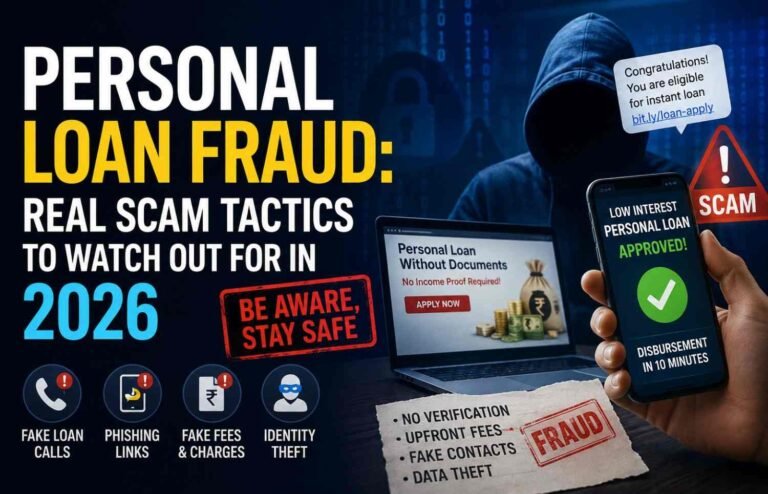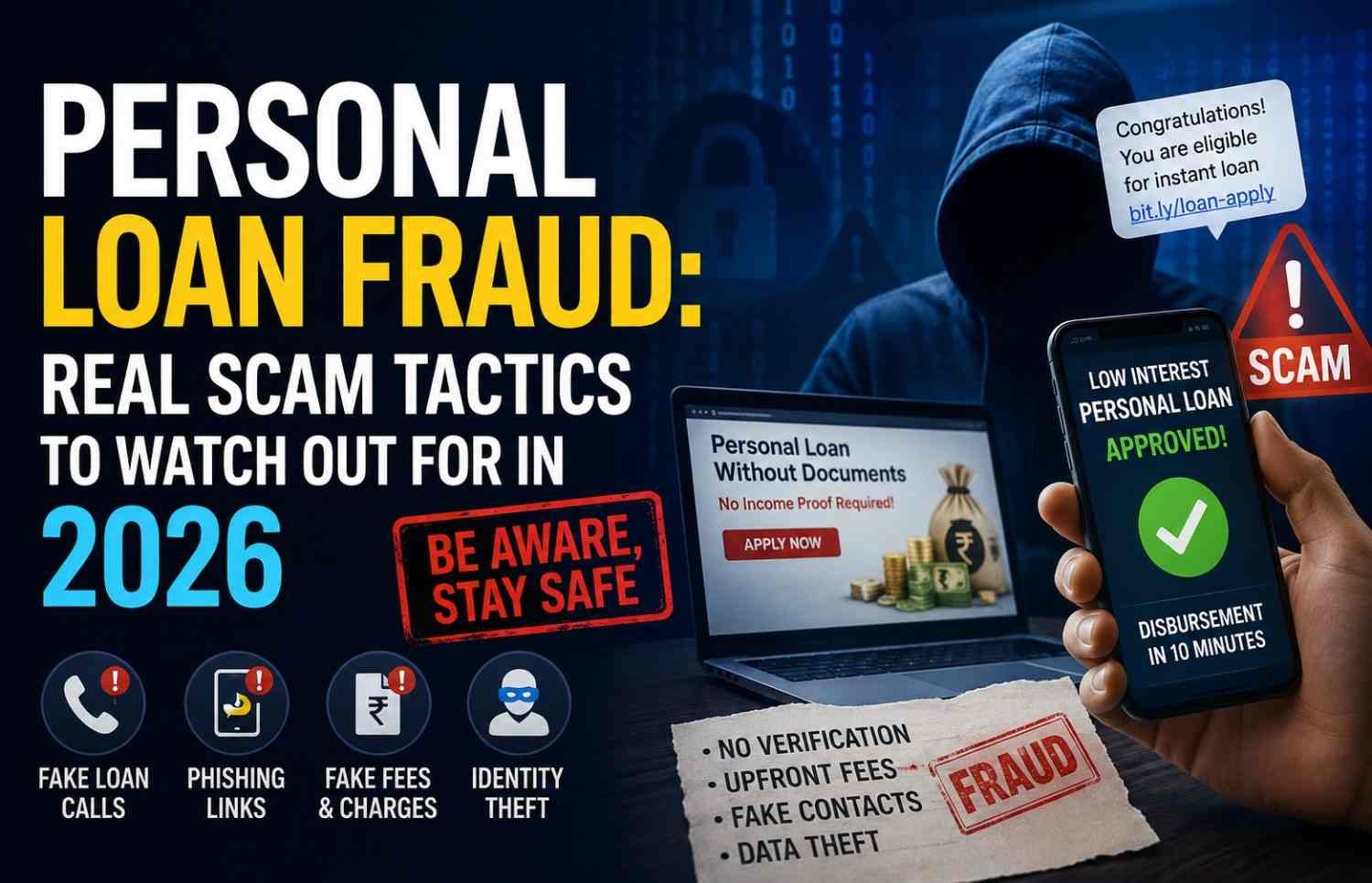
Getting a personal loan in India has never been faster, and neither has getting scammed while trying. As legitimate digital lending has expanded, a parallel fraud industry has grown alongside it, and in 2026 its tactics are more sophisticated than ever. Fraudsters no longer rely on clumsy fake websites and obvious spelling errors. They deploy AI-generated voices, deepfake video calls, and psychological pressure calibrated to catch people exactly when they’re financially stressed and least likely to think clearly.
The scale is significant. In December 2025 alone, the Indian government blocked 87 illegal loan apps under the IT Act, and the RBI removed 47 more from app stores as of March 2026. These crackdowns help, but scammers change app names constantly and shift to new channels the moment one is shut down. Awareness is the only reliable protection. Here are the real scam tactics operating in 2026, and exactly how to protect yourself from each one.
Tactic 1: The Upfront Fee Scam
This remains the most common form of personal loan fraud. The app or website approves your loan almost instantly, then demands an advance payment before disbursal, a “processing fee,” “GST charge,” “insurance premium,” “verification deposit,” or “refundable security.” You pay it. Then either the loan never arrives, or you’re asked for another fee, and another, until you stop.
The rule that defeats this scam is absolute: no legitimate lender ever asks for money before disbursing a loan. Genuine lenders deduct fees from the disbursed amount or bill them separately afterward, never as an upfront payment you make to receive the loan. The moment any lender asks you to pay before you receive funds, it’s a scam. Walk away.
Tactic 2: The Digital Arrest Scam
This is one of the most dangerous 2026 tactics, and it preys on fear rather than greed. Fraudsters pose as RBI officials, police officers, or CBI agents on a video call, often using deepfake video and AI-generated voices to appear convincing. They claim your Aadhaar or PAN is linked to money laundering or a fraudulent loan, and tell you that you are “digitally arrested.” They then demand money to “close the case.”
The truth is simple and worth memorising: real police, the RBI, and the CBI never conduct arrests over video calls, and they never demand money to close a case. Digital arrest does not exist as a legal procedure. Any such call is 100% fraudulent, regardless of how official the caller looks or how authentic the RBI logo behind them appears. Cut the call and report it.
Tactic 3: The Predatory Micro-Loan Trap
Here the scam disburses a real but tiny loan, Rs. 5,000 to Rs. 10,000, to build trust, with a brutally short 7-day repayment window and an annualised interest rate that can exceed 300%. When you can’t repay in time, penalty charges pile up, and the app offers a fresh loan to cover the old one. This creates a debt cycle that’s extremely hard to escape, with harassment escalating at every stage.
The defence is to never borrow from any app promising “instant loan, no CIBIL check, no documentation.” These promises are the signature of predatory lenders. A legitimate lender assesses your creditworthiness and discloses the full annualised cost (APR) in a Key Fact Statement before you accept. If the real cost is hidden and the repayment window is impossibly short, it’s a trap.
Tactic 4: The Data Harvesting and Blackmail Scam
Some apps never intend to lend at all. During “KYC,” they collect your Aadhaar, PAN, selfie, and bank details, and demand access to your contacts, gallery, and messages. No loan is ever disbursed. Instead, your data is sold or weaponised; scammers use your photos to create fake or morphed images and threaten to send them to your contacts unless you pay, even though you never received a loan.
The protection is to check app permissions before installing. Under RBI rules, no legitimate loan app can access your contacts, call logs, photo gallery, or media files. There is zero lending reason for an app to read your contacts. If an app requests these permissions, it exists to harvest and weaponise your data. Do not install it.
Also Read: How Online Blogging Improves Website Authority and Domain Trust
Tactic 5: The WhatsApp and SMS APK Scam
A newer 2026 channel bypasses app stores entirely. You receive a loan offer via WhatsApp, SMS, or social media with a link to download an APK file directly, outside the Google Play Store or Apple App Store. Because these files skip store review, they carry no scrutiny and often contain malware designed to steal data or take control of your device.
Never download a loan app from a link sent through SMS, WhatsApp, email, or social media. Use only official app stores, and even then, verify the app before installing. A legitimate lender does not distribute its app through messaging links that dodge store review.
Tactic 6: The Impersonation Scam
Fraudsters build apps, websites, or WhatsApp profiles that closely mimic well-known legitimate lenders. Names are subtly misspelt versions of real NBFCs. Logos are copied. Fake RBI registration certificates are displayed. Borrowers who don’t verify carefully believe they’re dealing with the genuine lender until the money, or their data, is gone.
Defeat this by verifying independently. Don’t click links inside any app or message. Open a browser, type the lender’s official website URL directly, and confirm it matches. For a genuine lender like Bajaj Finance, which operates the Bajaj Finserv loan app as an RBI-registered upper-layer NBFC, the official details are on bajajfinserv.in and in the RBI’s directory. If the app’s spelling, URL, or registration claims don’t check out against official sources, it’s an impersonation.
The Two-Minute Verification Routine
Every one of these scams fails against a short verification routine. Run it before sharing any information with any loan app:
- Check the RBI DLA directory. Every legitimate loan app must appear on the RBI’s Digital Lending Apps directory at rbi.org.in. If it’s missing, stop.
- Confirm the regulated lender is named. A genuine app clearly names the RBI-registered bank or NBFC funding the loan. No named lender means no legitimacy.
- Look for the Key Fact Statement. A real lender shows a KFS with the APR, total repayment, and all fees before you accept. Its absence is a red flag.
- Review permissions before installing. Contacts, gallery, call logs, or SMS access, any of these is a reason to reject the app outright.
- Never pay before disbursal. No legitimate lender charges a fee to release your loan.
These five checks take two minutes and eliminate virtually every scam pattern operating in 2026.
What Genuine Lending Looks Like
Contrast the scams with how a regulated lender actually operates. The Bajaj Finserv personal loan is disbursed only after you accept a Key Fact Statement disclosing the APR and all charges. Funds go directly to your bank account, never through a wallet or third party. The app requests no access to your contacts or gallery. Fees are deducted from disbursal or billed separately, never demanded upfront. And a named grievance officer is available for any dispute.
The eligibility is transparent: salaried applicants aged 21 to 80, minimum monthly income of Rs. 25,000 (higher in metros), and a CIBIL score of 685 or above, for loans of Rs. 40,000 to Rs. 55 lakh at rates starting from 10% p.a. There are no shortcuts, no “guaranteed approval without CIBIL,” and no upfront payments, because legitimate lending doesn’t work that way.
What to Do If You’ve Been Targeted
If you’ve already interacted with a suspected scam, act fast. Revoke the app’s permissions immediately through your phone settings, block access to contacts, SMS, and gallery, then uninstall it. Change your net banking passwords and UPI PINs. If you shared card details, block the card.
Then report it. Call the cybercrime helpline at 1930, or file a complaint at cybercrime.gov.in with screenshots and transaction records. You can also report through the RBI’s SACHET portal at sachet.rbi.org.in. If you face blackmail or harassment involving your contacts, report each instance, and never pay, as payment only invites more demands.
The Bottom Line
Personal loan fraud in 2026 is more sophisticated than ever, using deepfakes, AI voices, fake arrest threats, and messaging-app malware to catch people at their most vulnerable. But every one of these scams shares the same weaknesses: an unregistered app, no Key Fact Statement, a demand for upfront payment, or a request for access to your personal data. Any one of these signals is enough to walk away.
Protect yourself with the two-minute routine every single time: verify the personal loan app on the RBI’s DLA directory, confirm the regulated lender is named, demand the Key Fact Statement, check permissions, and never pay before you receive funds. Borrow only through regulated apps like Bajaj Finserv that operate transparently under RBI oversight. In digital lending, the speed of a loan matters, but the legitimacy of the lender matters far more. A few minutes of verification is the cheapest insurance you’ll ever buy.
About the Author